WALTERS-EG
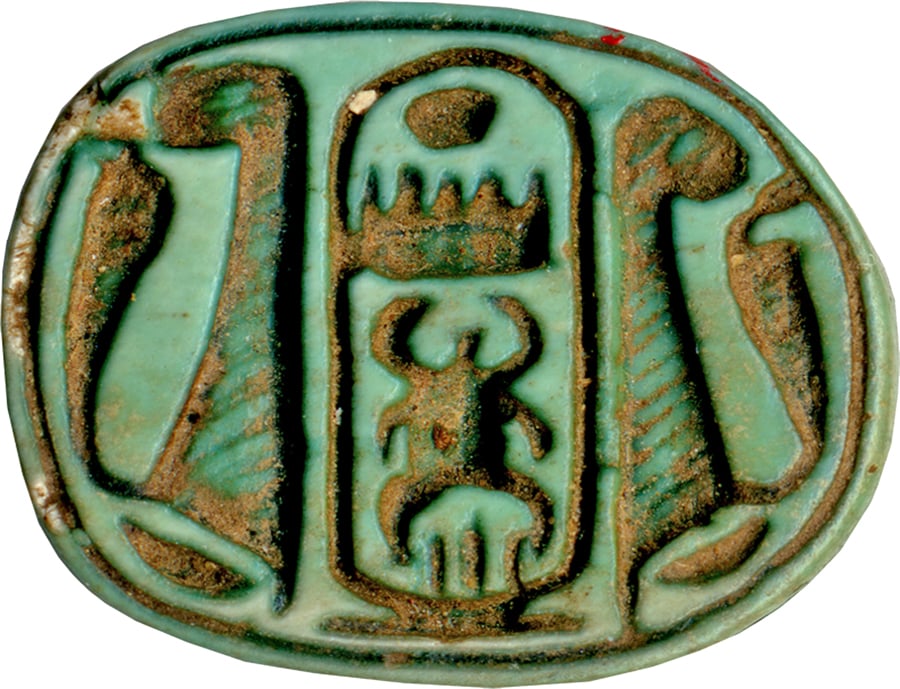
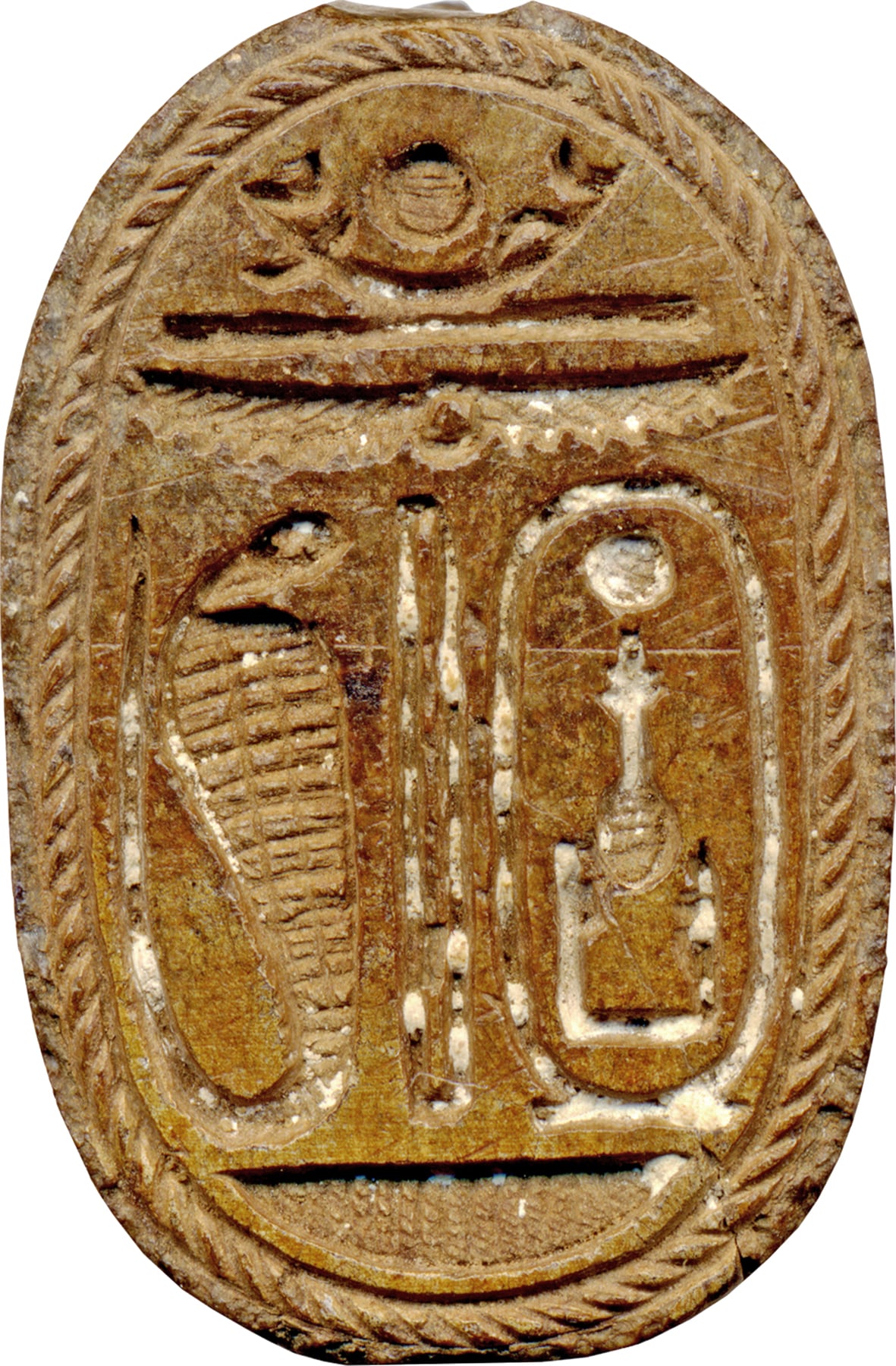
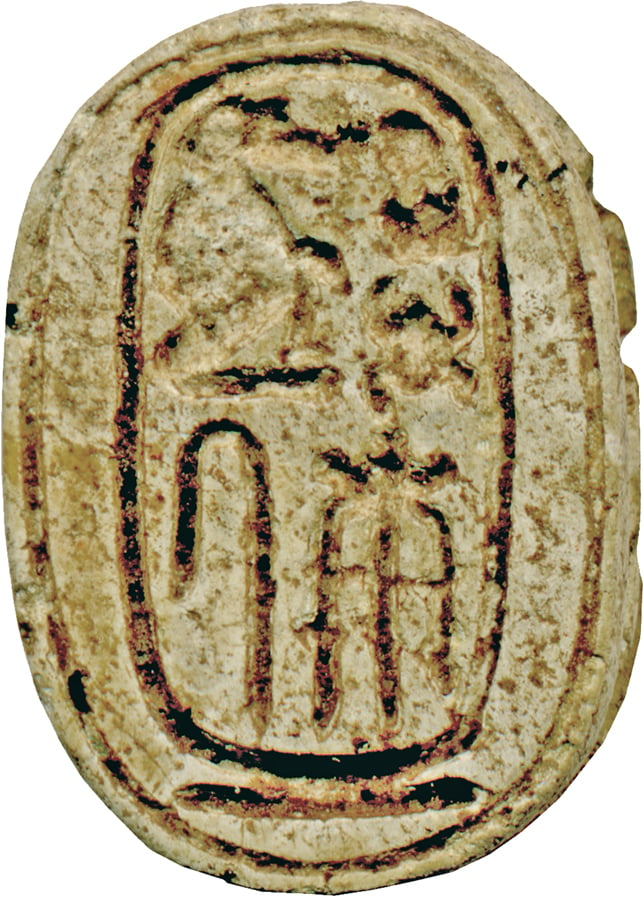
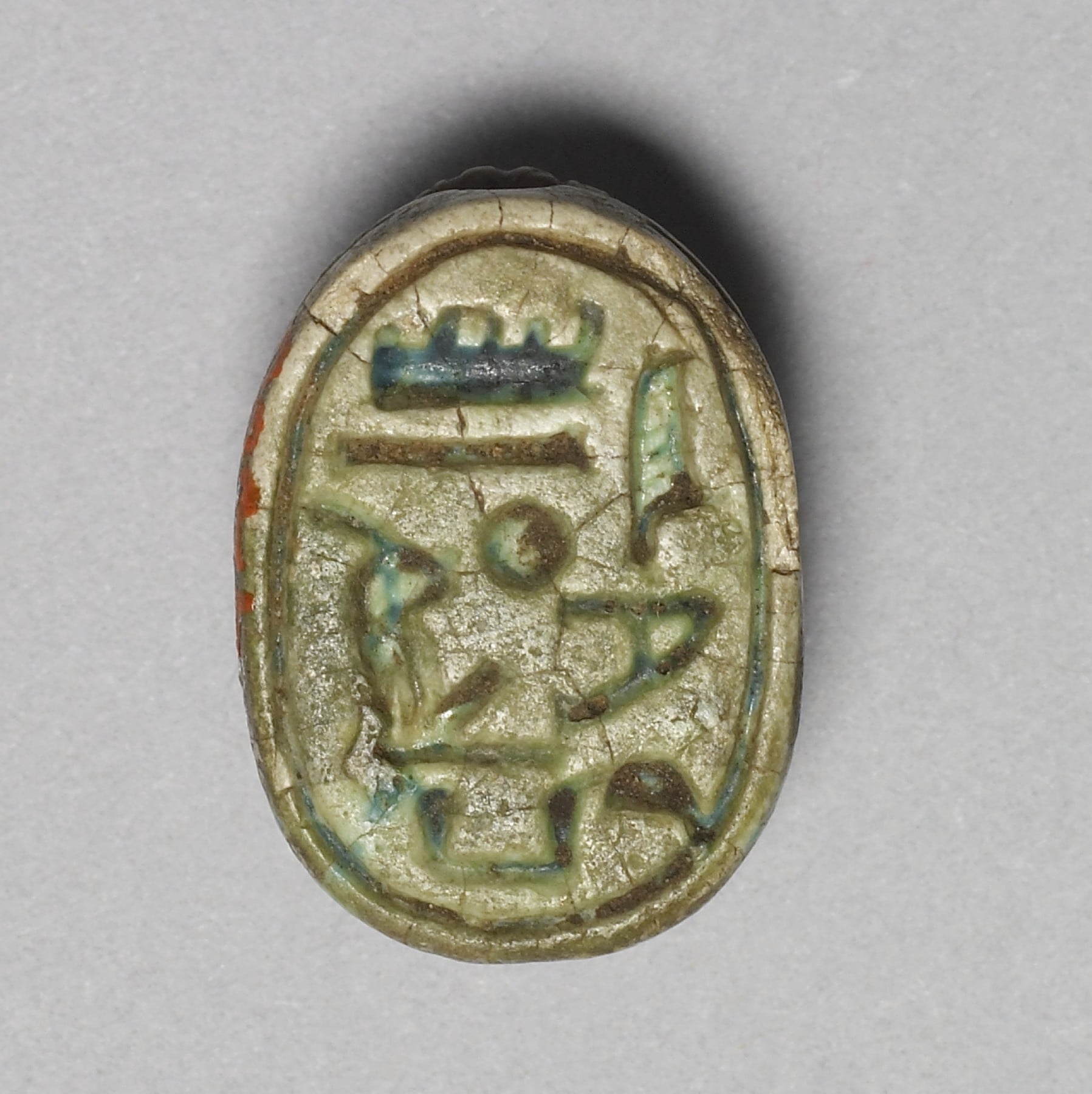
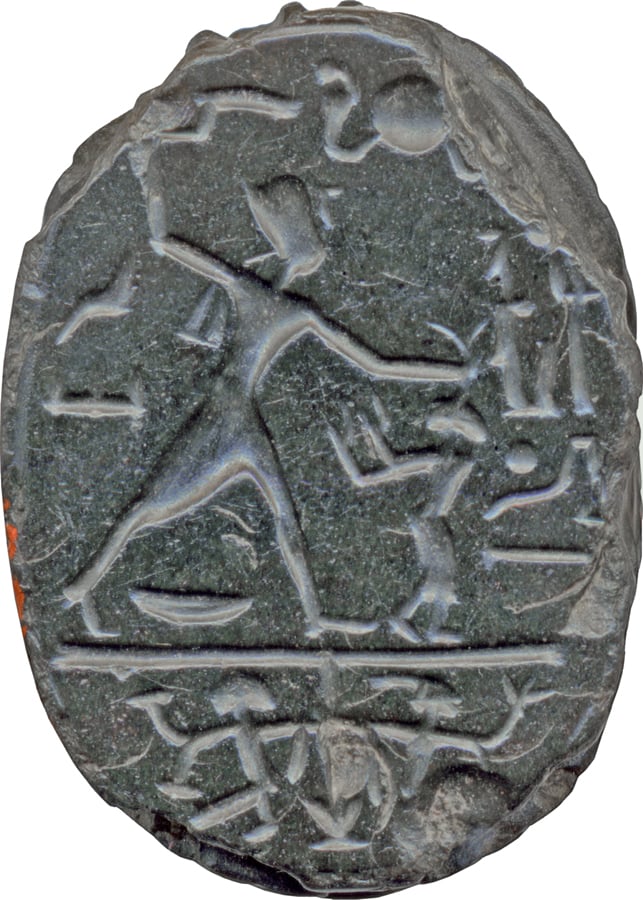
<p>The ancient Egyptians believed that the dung beetle, the Scarabaeus sacer, was one of the manifestations of the sun god. Representations of these beetles were used as amulets, and for ritual or administrative purposes. The scarab displays a ritual scene on its bottom, which shows the standing figure of King Ramesses II in front of the god Thoth. The king wears the so-called "Blue Crown" with Uraeus-serpent and crown sash, as well as a long elaborate, pleated dress. He presents a squatting figure of the goddess Maat with his right hand, while his left hand is raised in an adoration gesture towards the god. Thoth, the god of wisdom, is depicted as a squatting baboon with the hands upon his knees, and moon disk combined with crescent above his head. Above both figures appears an inscription, containing Ramesses' royal throne name without a cartouche. Below both figures is a large mr-sign, which functions as base for both figures. The nb-sign in the lower round is not only a filler character, but also creates a balance to the inscription in the upper round. The layout of the figures and hieroglyphs is balanced, only the moon-ensemble and the sun disk are somewhat deformed and collide with the borderline. The figure of Ramesses II is very slim in comparison to the compact figure of the baboon-shaped god. The moon crescent and disk are not attached to the deity and have the same distance to the head of the god as the sun disk does to the head of the king. The pleated dress of the king and the mane of the baboon have hatch lines, the mantel of the baboon has a crossed-line pattern. The highest point of the scarab's back is the pronotum (dorsal plate of the prothorax). Pronotum and elytron (wing cases) show dark blue glazed borderlines, single separation lines, and V-shaped marks for humeral callosities (shoulder thickenings). Small side-depressions are visible below the pronotum. The semicircular head is flanked by triangular eyes. The side plates are irregularly trapezoidal and have curved outer edges, and the clypeus (frontal plate) is four times serrated. The proportions of the top are well balanced. The raised extremities are slender and have natural form, with vertical hatch lines on the upper sides for the tibial teeth and pilosity (hair). The background between the legs is deeply hollowed out. The base is long-oval, and the drill-hole openings framed. The scarab is longitudinally pierced, was originally mounted or threaded, and functioned as an amulet. The presentation of the Maat-figure by Ramesses II to Thoth is part of the ritual, in which the king states to follow and strengthen the ethical rules. This version of the motif has a second level of meaning: Thoth appears in his moon-god function, and the king, with the sun disk above his head, as representative of the sun god, father and creator of Maat (principle of justice, truth, and order). They meet to strengthen Maat in this and the other world, and the throne name of the king can be read in two directions, and interpreted as: "Strong is the Maat of Re", but also as "Strong is the Maat of Thoth". Therefore, it is likely that the scarab was made for a funeral context, either for the burial of the king himself, or for a private person, who trusted in the divine, Maat-guaranteeing power of the king.</p><p>For the latest information about this object, <cite><a href='https://purl.thewalters.org/art/42.31' rel='external'>Scarab of Ramesses II</a></cite>, visit the Online Collection of the Walters Art Museum.</p>
A machine reading of the photograph made Jul 2026: deities, names, signs and a description as the model saw them. Not curatorial; treat it as the model's best reading, not authority.
Spotted an error, a mis-mapped findspot, or have a suggestion? We read every note.