WALTERS-EG
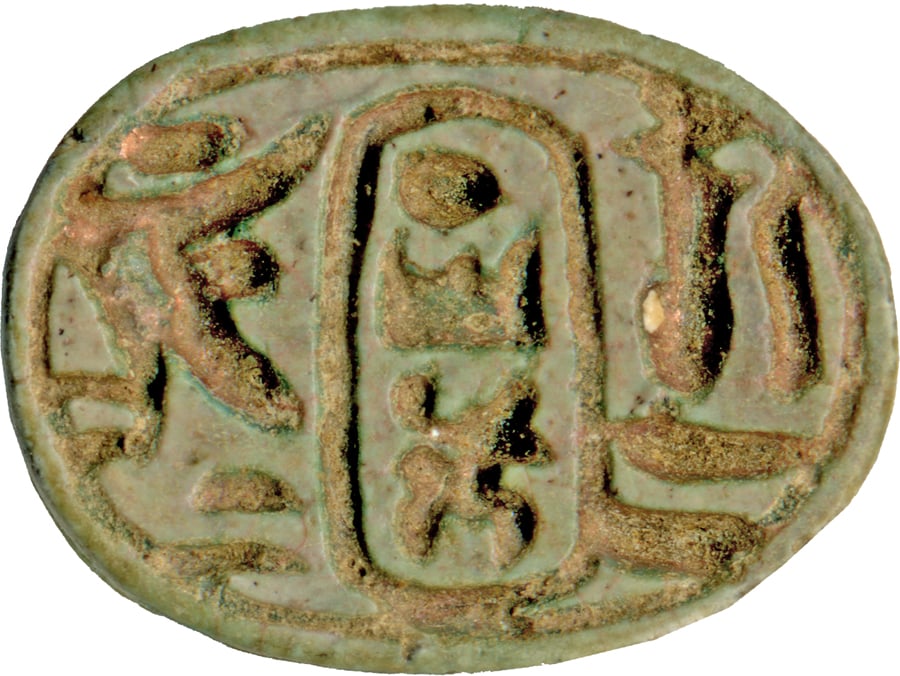
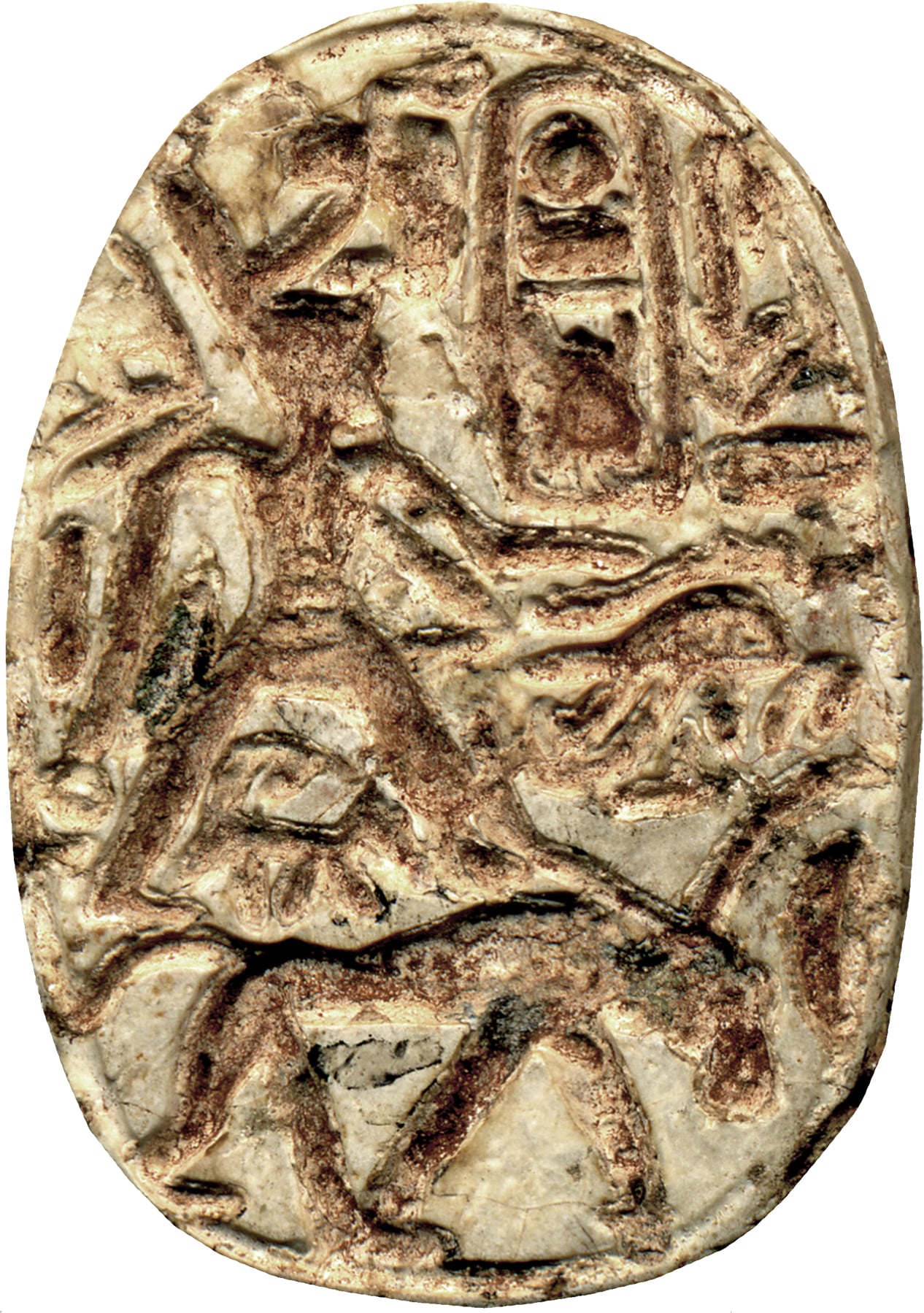
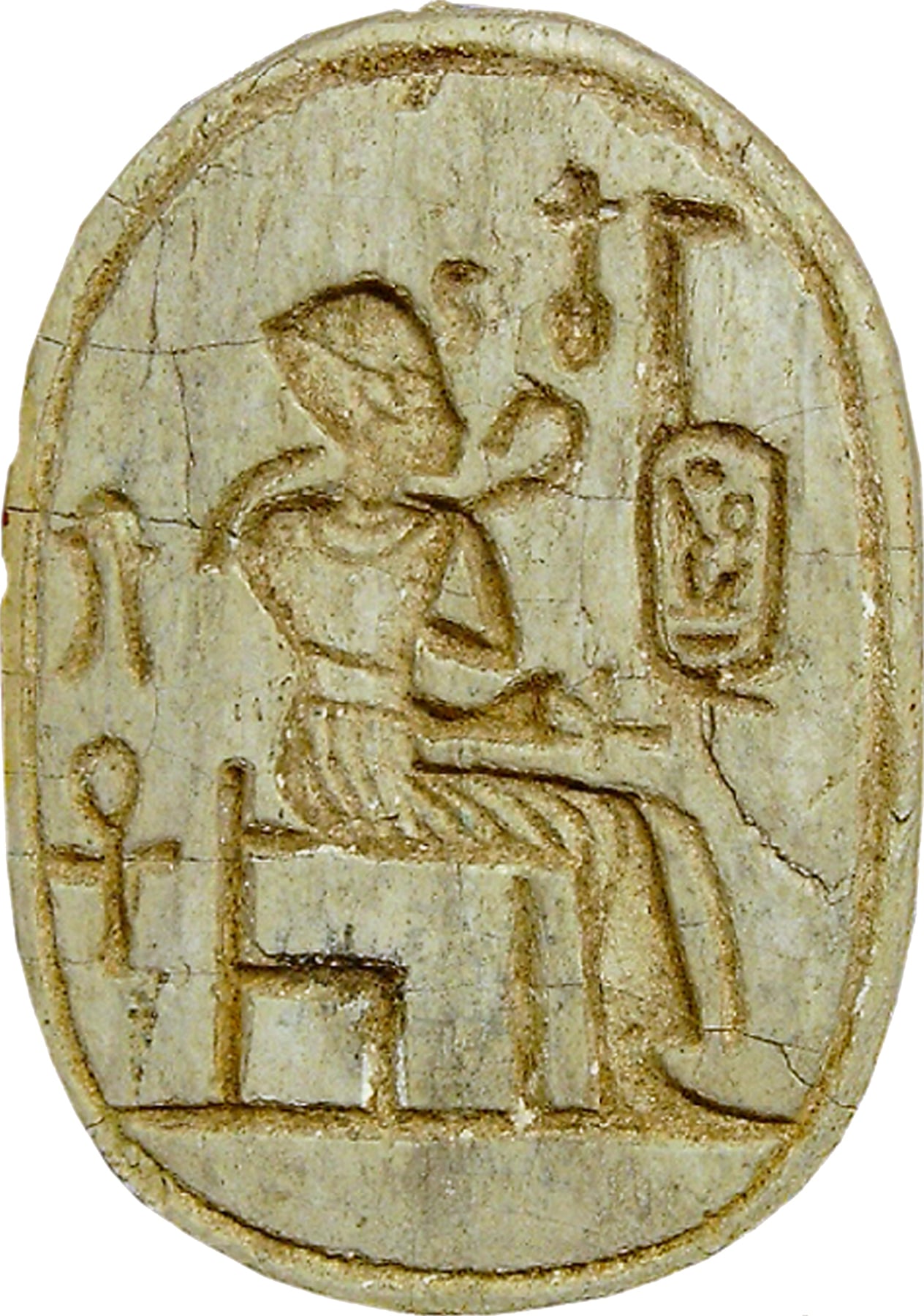
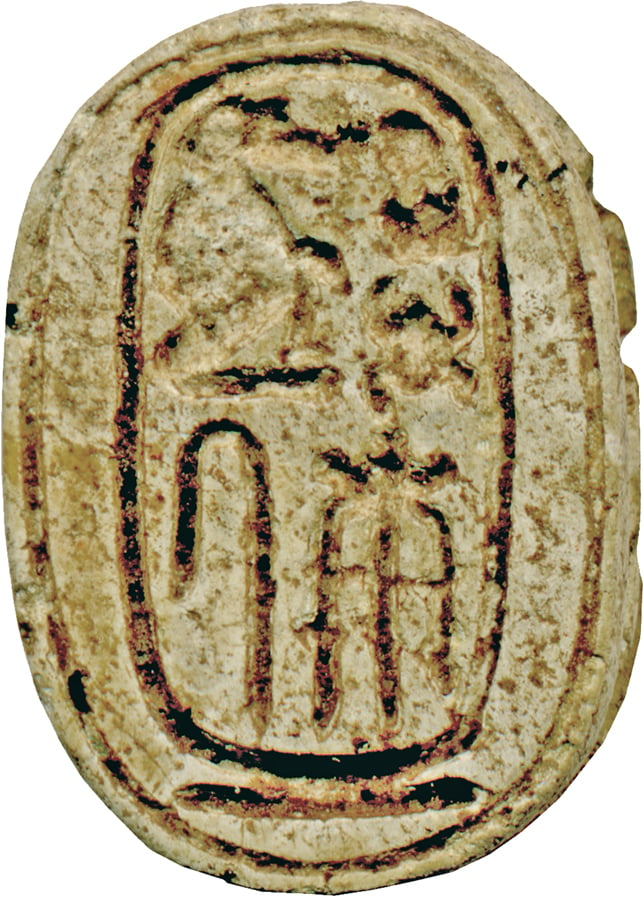
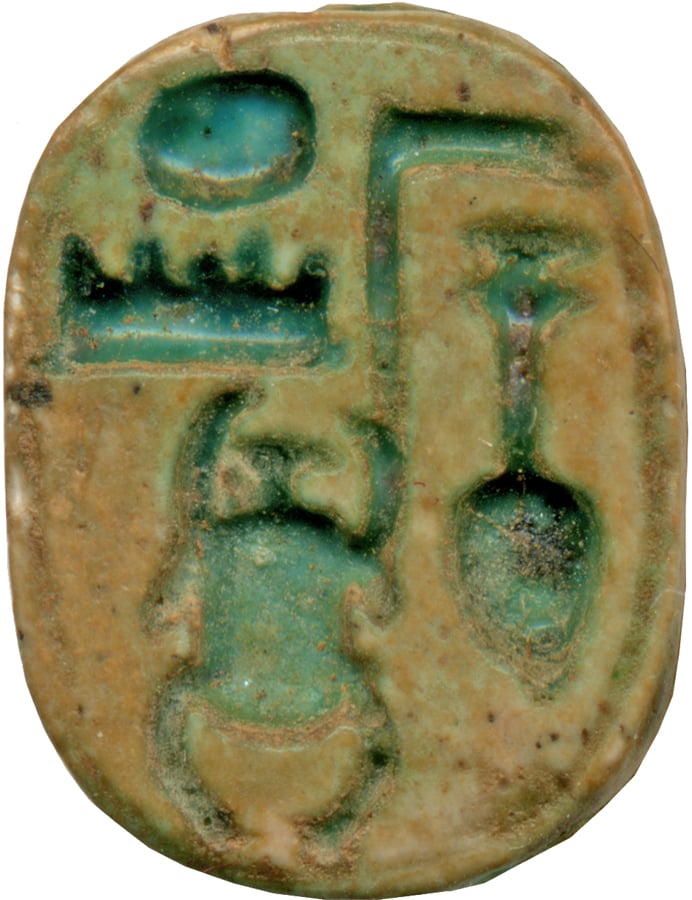
<p>The ancient Egyptians believed that the dung beetle, the Scarabaeus sacer, was one of the manifestations of the sun god. Representations of these beetles were used as amulets, and for ritual or administrative purposes. This scarab has a bottom inscription, which consists of three columns, framed by an oval line; the central column has a royal cartouche. The text contains the name, titles, and epithets of King Thutmose III. The inscription is carved in sunken relief. The layout is arranged to fit in the oval frame, but the two outer columns are not well balanced, and some signs collide with the borderline. The shape of the hieroglyphs is slightly rough, and the nfr-sign has three instead of two horizontal lines. The highest point of the back is partition between pronotum (dorsal plate of the prothorax) and elytron (wing cases). Pronotum and elytron display incised borderlines, single separation lines, and V-shaped marks for the humeral callosities (thickenings at the shoulders). The borderlines of the elytron ends at the rear in half spirals. The proportions of the top are unbalanced, the pronotum and head section are short in comparison to the elytron. The head has long-oval shape, the side plates are irregularly trapezoidal, and clypeus (front plate) shows a central base notch. The carved extremities show natural form, and vertical hatch lines on the upper sides for the tibial teeth and pilosity (hair). The symmetrical base has a long-oval shape; and the drill-holes of the scarab are framed. The scarab is longitudinally pierced, was originally mounted or threaded, and functions as an amulet. This amulet should ensure for its owner support by the royal authority (cartouche) of the divine king (title: "Perfect God"), and all-inclusive protection (epithet: "who reverses the foreign countries".) The scarab was produced after the death of King Thutmose III, who was most probably understood as a protective god and successful model of divine kingship.The change of the royal title nb t3.wj "Lord of the Two Lands" to nb t3.w "Lord of the Lands" may be either a writing mistake, or a variant to make the title match to the plural form in the epithet formula "all foreign countries." The esthetical balance of the signs (four horizontal signs at each side of the cartouche) may have played a role also.</p><p>For the latest information about this object, <cite><a href='https://purl.thewalters.org/art/42.32' rel='external'>Scarab with the Cartouche of Thutmosis III</a></cite>, visit the Online Collection of the Walters Art Museum.</p>
A machine reading of the photograph made Jul 2026: deities, names, signs and a description as the model saw them. Not curatorial; treat it as the model's best reading, not authority.
Spotted an error, a mis-mapped findspot, or have a suggestion? We read every note.