Khnum
Description
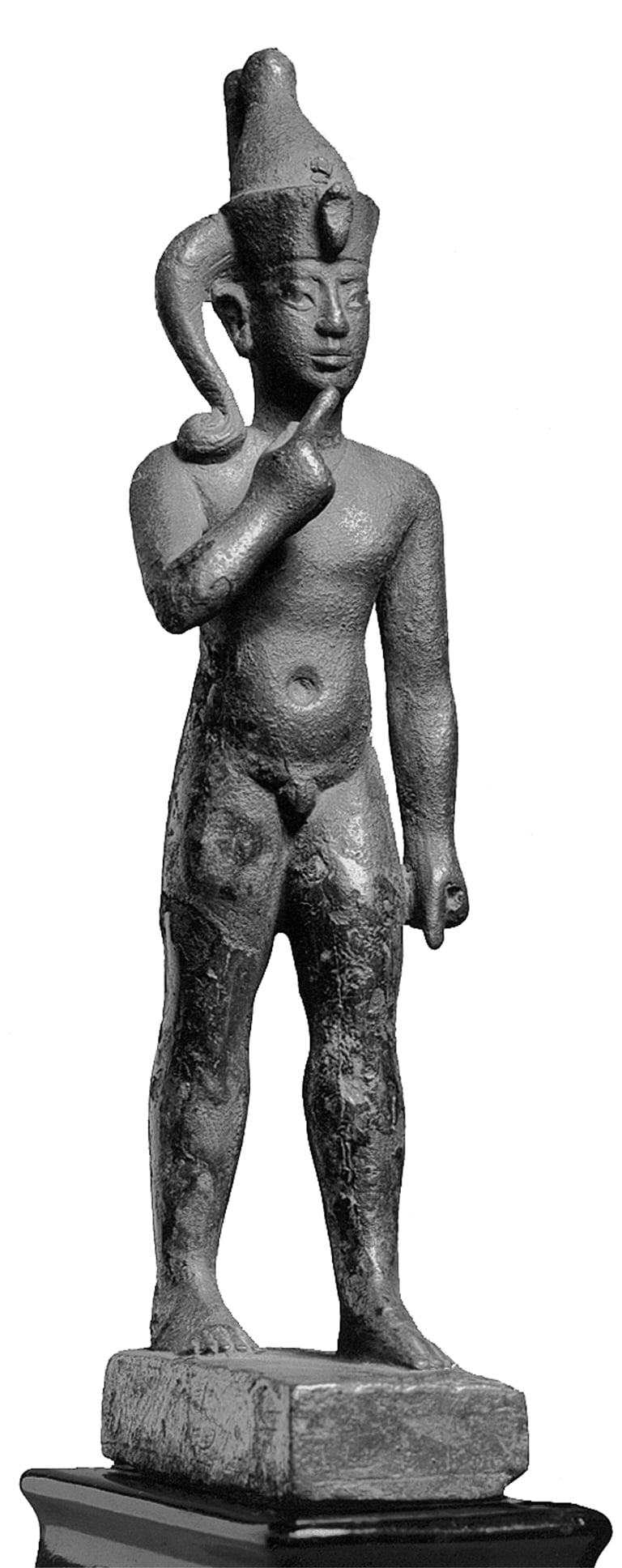
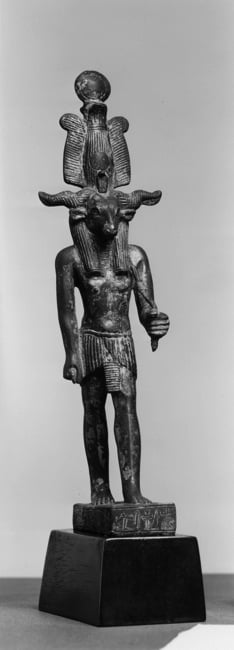
<p>Khnum holds a whip in his right hand. The inscription says that this votive figure was dedicated by King Psametik. As in large scale Egyptian granite standing or striding figures, there is no space between the legs, and the arms are kept close to the body. The headdress has broken off.</p><p>For the latest information about this object, <cite><a href='https://purl.thewalters.org/art/22.342' rel='external'>Khnum</a></cite>, visit the Online Collection of the Walters Art Museum.</p>
AI image analysis GPT-5.4-nano
Machine-generated from the object's image on Jul 2026. Not curatorial; treat deities, names, and signs below as the model's best reading, not authority.
A black-stone seated/standing male deity figure holding one hand to the chest and the other arm crossed over the body, shown standing on a decorated rectangular base.
The image shows a single freestanding Egyptian-style figure carved in dark stone. The figure has a human body with a stylized wig or headcloth, and wears a short, pleated kilt with a belt-like sash. The left arm is held across the torso, while the right hand rests near the chest. The figure stands on a rectangular pedestal whose front face contains incised decoration resembling bands or registers with geometric/architectural forms; specific hieroglyphs are not clearly legible at this resolution. No Greek/Coptic/Arabic text is visible. The catalogue title identifies the object as “Khnum”; the depicted deity figure type and ram-related iconography are not clearly confirmable from this image alone, so the identification cannot be verified visually with confidence.
Inscriptions (1)
English description
Connections
Cross-references (2)
- Walters-AccNum 22.342 tier-2
- Walters-id 8061 tier-2
Similar inscriptions · by content embedding
About this record's data
- From the source institution — accession, description, dimensions, and dating are as catalogued by Walters Art Museum (Egyptian).
- AI-inferred — the image-analysis panel (deities, names, signs) is machine-generated and may be wrong.
- Approximate location — most map points are plotted at the site centroid, not the exact findspot.
- Inferred links — cross-references marked with a match method other than explicit-source-field were matched by us, not stated by the source.