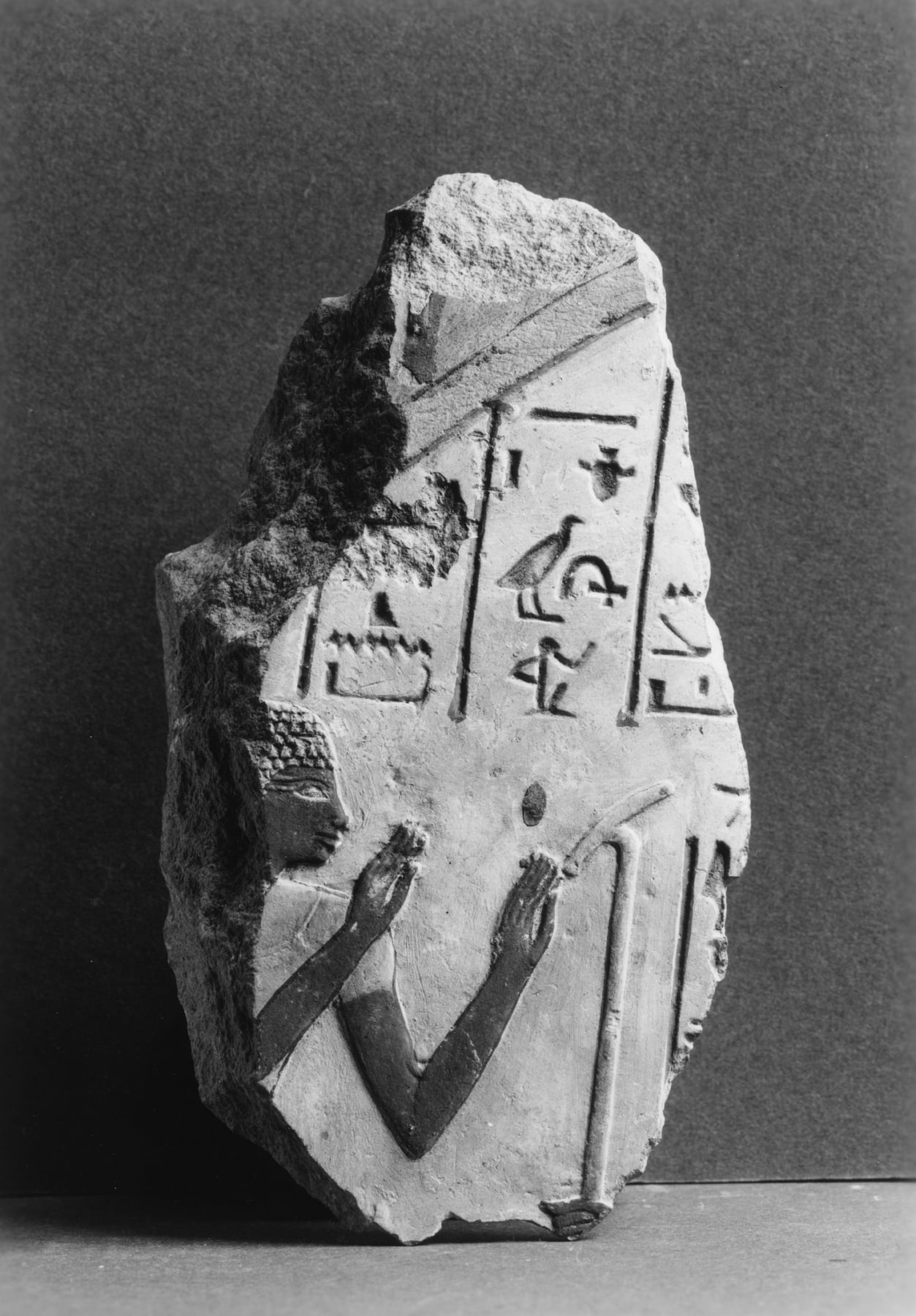
Stele with King and Ptah
Description
<p>This stele is carved in low relief and depicts a King and Ptah facing each other across an offering table. There are inscriptions on the top, bottom, and edges. The corners are broken. The authenticity of this piece is questioned.</p><p>For the latest information about this object, <cite><a href='https://purl.thewalters.org/art/22.319' rel='external'>Stele with King and Ptah</a></cite>, visit the Online Collection of the Walters Art Museum.</p>
AI image analysis GPT-5.4-nano
Machine-generated from the object's image on Jul 2026. Not curatorial; treat deities, names, and signs below as the model's best reading, not authority.
A small arched Egyptian stele shows a frontal king flanked by two standing figures, with a central hieroglyphic panel and winged/architectural elements above.
The image depicts an arched, upright stele in profile view facing the viewer. In the upper register a winged, hawk-like form spans across the top above a central recessed panel that contains hieroglyphic-style signs and a small seated/standing figure or emblem. Below, three main figures stand in a symmetrical arrangement: the central royal figure (king) holds a long staff/ceremonial object; to either side stand two attendants or priests, each holding staffs and wearing traditional patterned garments. Behind/around the central panel are architectural motifs resembling columns. At the base there is a horizontal band with additional markings that may be inscription or decorative text. The stone surface is worn in places, but the overall iconography is consistent with a dedication stele involving the king and a creator god. No readable Greek, Coptic, or Arabic text is visible. Some Egyptian hieroglyphic signs appear but are too worn/low-resolution to transcribe reliably.
Inscriptions (1)
English description
Cross-references (2)
- Walters-AccNum 22.319 tier-2
- Walters-id 23856 tier-2
Similar inscriptions · by content embedding
About this record's data
- From the source institution — accession, description, dimensions, and dating are as catalogued by Walters Art Museum (Egyptian).
- AI-inferred — the image-analysis panel (deities, names, signs) is machine-generated and may be wrong.
- Approximate location — most map points are plotted at the site centroid, not the exact findspot.
- Inferred links — cross-references marked with a match method other than explicit-source-field were matched by us, not stated by the source.