Walters Art Museum (Egyptian) · statue

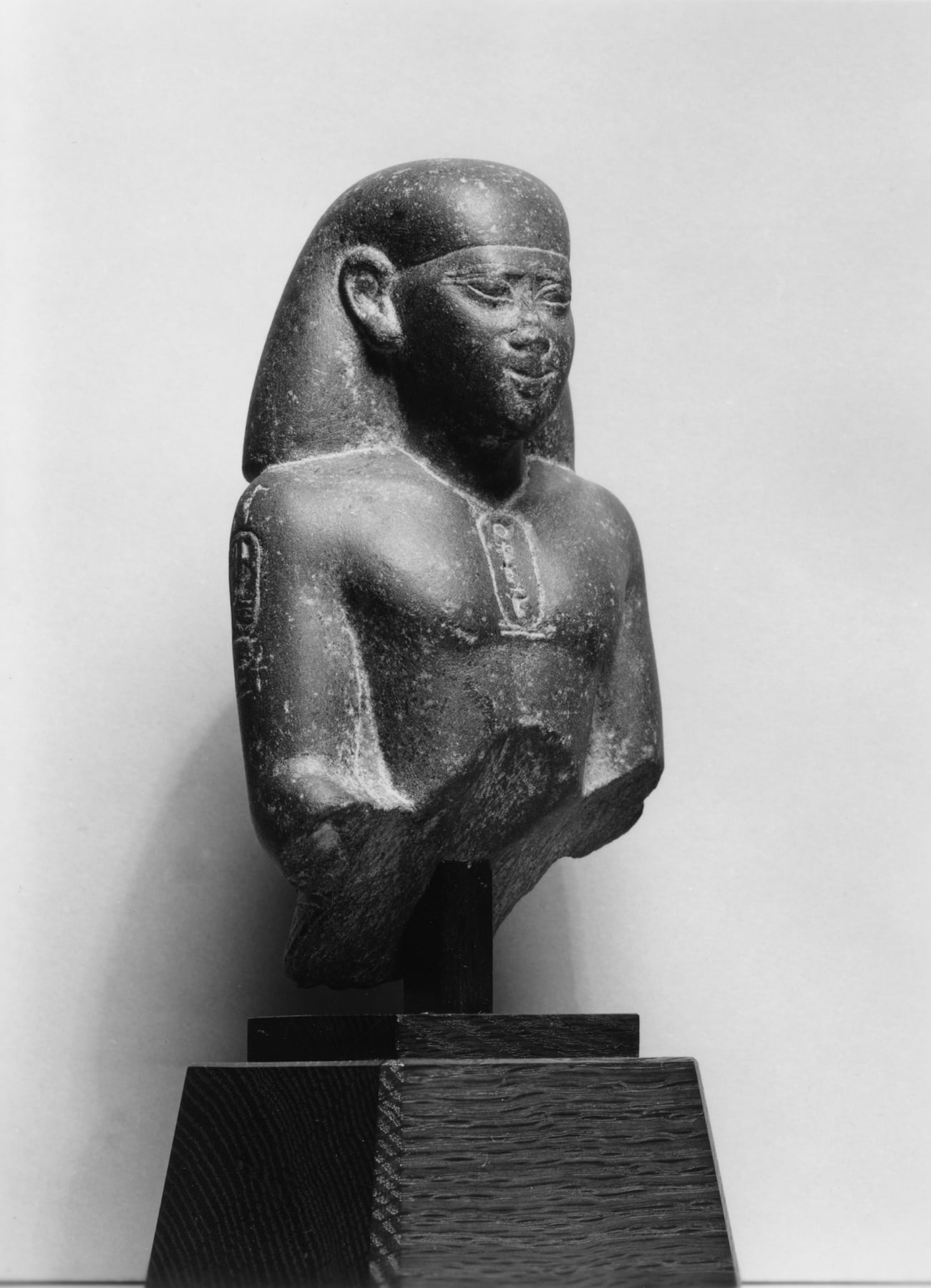
Statue of a Vizier, Usurped by Pa-di-iset

Source of record: Walters Art Museum (Egyptian) — catalogued by the holding institution. View the original record →

Description

<p>A remarkable example of the re-use of a work of art, reflecting the course of Egypt's long history, this statue was originally carved to commemorate a powerful government official. A thousand years later the inscription naming this unknown man was erased, and a carved scene was added depicting its new owner, Pa-di-iset, son of Apy, worshipping the gods Osiris, Horus, and Isis. From a text on the rear of the statue we learn that Pa-di-iset was a diplomatic messenger to the neighboring lands of Canaan and Peleset (Palestine).</p><p>For the latest information about this object, <cite><a href='https://purl.thewalters.org/art/22.203' rel='external'>Statue of a Vizier, Usurped by Pa-di-iset</a></cite>, visit the Online Collection of the Walters Art Museum.</p>

AI image analysis GPT-5.4-nano

Machine-generated from the object's image on Jul 2026. Not curatorial; treat deities, names, and signs below as the model's best reading, not authority.

Dark stone standing statue of a kneeling/sitting vizier-like figure, wearing a straight wig and formal garment, with traces of incised decoration and possible inscriptions on the base area.

The object is a small, dark gray-black standing or seated statue shown front-facing against a neutral background. The figure has a heavy, stylized nemes-like wig or wrapped head covering with defined ears and a calm facial expression. The torso is rendered with minimal detail; the upper garment is a smooth, close-fitting form. The lower portion shows a pleated or kilt-like garment with a vertical seam or folds. The legs descend to a small, integrated base or pedestal, where a band of incised decoration and/or hieroglyph-like signs is visible but not fully legible at this resolution. No Greek/Coptic/Arabic text is visible. No clear royal cartouche is distinguishable from the image; the inscription (if present) appears more associated with the figure’s base/ground line than with an overt royal name. The overall finish appears polished with worn/abraded surface details, especially around the face and lower carved areas.

royal Likely Late Period to early Ptolemaic (or otherwise Old/Middle Kingdom-style vizier statue conventions), but exact period unclear from this image alone. good
Materials dark gray-black stone (catalogue says graywacke)
Signs incised decorative band / possible hieroglyphs (not legible)

Inscriptions (2)

Inscription #1

English description

[Translation] caption of the scene on the kilt: Ka of Osiris: Pa-di-iset, the justified, son of Apy.
Inscription #2

English description

[Translation] on the back pillar: The only renowned one, the impartial envoy of Philistine Canaan, Pa-di-iset, son of Apy.

Connections

Deities HorusOsirisIsis

Cross-references (2)

  • Walters-AccNum 22.203 tier-2
  • Walters-id 33246 tier-2
About this record's data
  • From the source institution — accession, description, dimensions, and dating are as catalogued by Walters Art Museum (Egyptian).
  • AI-inferred — the image-analysis panel (deities, names, signs) is machine-generated and may be wrong.
  • Approximate location — most map points are plotted at the site centroid, not the exact findspot.
  • Inferred links — cross-references marked with a match method other than explicit-source-field were matched by us, not stated by the source.